
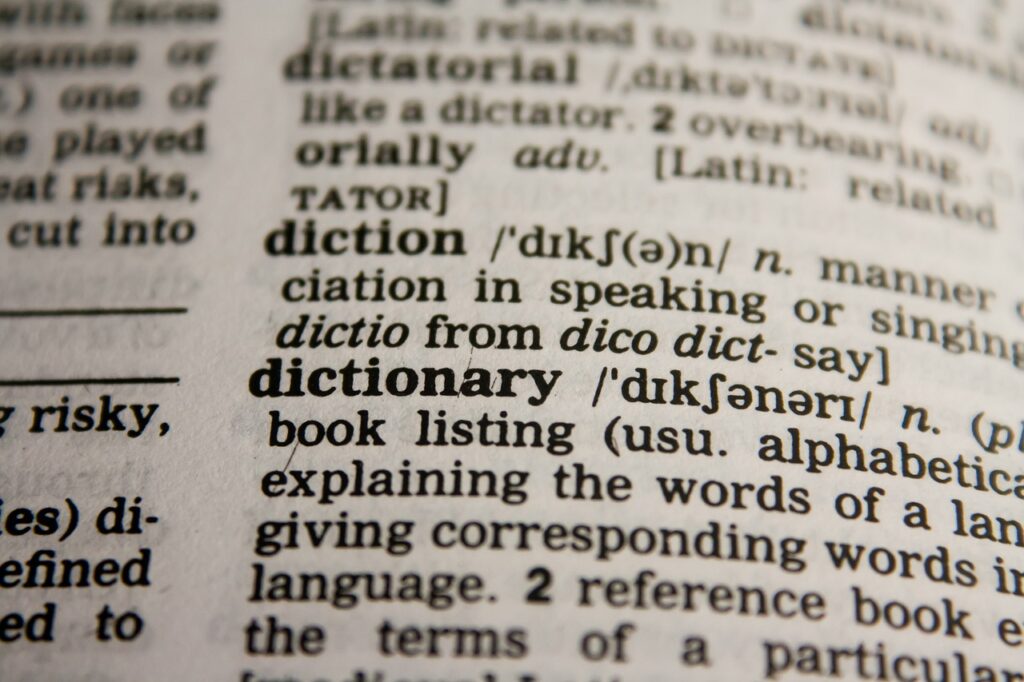
Learn to Listen
To increase your income options, you need to learn to listen. Then, learn to talk.
Start here. Do you listen to instructions? Instructions are steps to succeed at something. When you buy a bookshelf in a box, it comes with instructions. If you follow those instructions, you will succeed at building the bookshelf.
Granted, those were written instructions, but there are many other opportunities to listen to instructions, such as on YouTube, in classes, etc. Listen well and you will increase your chances for success.
Listening should be active. Listen to hear the lesson. Listen to hear the steps. Listen to hear the measure of success. What is not clear should become a question. Then repeat the answer to show you understand.
You Need Words to Talk
If you speak English, you could learn up to 500,000 words, compared to 135,000 words in German, and less than 100,000 in French.
Lucky for you, though, the Oxford English Dictionary notes that only 171,476 words are in current use. But, if you read a lot, you might need to know another 47,156 obsolete words.
Not everyone uses all those words. In fact, if you listen carefully, there are many people who use very few words! They reveal that in their conversation. Cuss words can become the replacements for words they never learned!
Keep in mind that offensive language will not win friends and influence people. That is not the language of success.
Build on Your Average
Per the AI Overview on Google, the average English speaker is estimated to know between 20,000 and 35,000 words, based on data from The Economist. What is your average?
University educated people would know closer to 40,000 words. Most people use about 5,000 words in everyday conversation. Those averages mean that most people know less than 10% of what is available to know or less than 20% of currently used words.
There are methods to learn more. And learning a little at a time will help you retain those words in your memory.
Do you understand all the conversations around you? Do you understand all that you hear from the news on TV or radio? You might need to learn more words.
Your Vocabulary Can Accumulate
Your being able to talk and communicate will depend on your knowledge of words. Your ability to follow instructions on the job will depend on your knowledge of words. Your ability to give clear instructions as a supervisor will depend on the words you are able to use.
So, build a good vocabulary to keep your job and get noticed for raises. Your success depends on your vocabulary!
There are many sources to make improvements in your vocabulary. However, I came across a book which might be a good place to start. It is Vocabulary & Spelling Success, by LearningExpress, LLC.
This book begins with a Pretest, which includes answers. Then, Chapter 2 covers Vocabulary Terms and Language Origins. You will learn vocabulary from the sound of words, the structure of words, and the context of words, as in how they are used.
As you read, you can add words to your vocabulary with those words that seem unfamiliar. You can look the word up and review how it was used in the sentence. This may take a couple of minutes, but that process will set that word in your memory and will be understood the next time you see it and you will be more apt to use it in conversation or in writing, where appropriate.
Chapter 3 is about Spelling Rules. If nothing else, this chapter will help you remember how to sound and spell the words you already know, without using Spell Checker! You can learn more about how words should be used with Rules related to hyphens, apostrophes, contractions, plurals, prefixes, endings, abbreviations, possessives, vowels, and their exceptions which can be learned to help you communicate better!
The following 15 chapters have lists to help you with:
- Prefixes.
- Suffixes.
- Learning Roots.
- More Roots.
- Foreign Language Terms Used in English.
- Business Terms.
- Technology Terms.
- Legal Terms.
- Terms Related to Language and Literature.
- Short Words That Mean a Lot.
- Adjectives.
- Acronyms.
- Commonly Tested Words.
- More Commonly Tested Words.
- Philosophical Terms.
There is a Post Test, with answers, to test how well you have added to your vocabulary. If you test well, you should have added over 600 words to your vocabulary along with the ability to use the words you already knew better than before!
Learn to Speak
As you add to your vocabulary, you can learn how to pronounce those words. That will help you both with your reading and when you speak.
People can tell a lot about what you know when you speak. If you really know words you can prove you do by how you pronounce them.
I know that sounds a bit petty. But listen to how others speak and make your own evaluation. In perspective, the more words you have in your vocabulary the better you will understand what I mean.
Remember, you must be consistent. Adding thousands of words can take a while.
Why Learn to Talk?
A decent vocabulary will help you talk better. And it will help you text better, since we seem to do that more than talking these days.
Plus, in business you have a better chance for advancement if you can talk or use written communication. To some, this can seem ominous (scary!). But a consistent effort to learn more words will give you an advantage over those who fail to pursue personal improvement in these skills.
As my goal for this blog site is to help you build a better mindset for money, I try to pass on any insights I can to help you gain and maintain the ability to earn an income to provide for all the other facets of your life related to money.
Learning how to talk will help you in every facet of your life!