
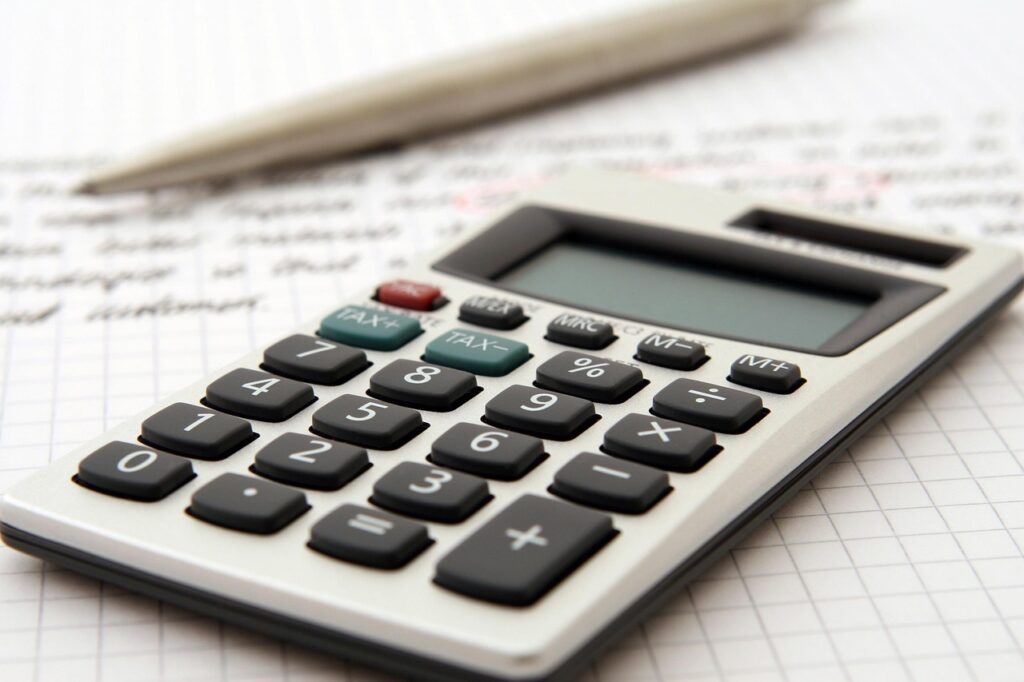
Math Related to Money
When we think of money, we think of numbers. When we think of numbers, we know that we will need math skills. Those math skills will include adding, subtracting, dividing, and multiplying, inside formulas and other measures.
That sounds simple. However, many people, me included, have gotten into trouble with their money because we have ignored the math needed for better decisions.
Money math will help you see if what you earn will cover what you want or need to spend. Some things we can control and some things we cannot control. But we can have more control over and have better experience with money if we remember to do the math!
Too Much for One Post
There are many books that include math related to money. I will offer a few references that will leave a trail for further study, if you feel you need to know more about a topic. I do encourage further research.
Some of my reasoning and formulas may sound simple to you because of your experience. However, many of my younger readers may find this useful and helpful when they are facing the purchase of an automobile or a house, calculating how much rent they can afford, or determining what to do with a paycheck, including the payroll deduction choices.
My hope is that you will build a better mindset for money and be willing to share with those who are not making good choices with their money. Remember, choices accumulate. Help others accumulate good results instead of bad results with their money decisions by doing better with money math!
I must make a series of posts to give the subject of money math adequate consideration. The various circumstances that you will face for financial decisions will require you to use a variety of money math formula options. There are too many for one post. But don’t be alarmed. You can learn what you need to know to be more confident in your money math decisions.
Cost to Benefit
Sometimes money math may seem straightforward. However, in my mind, we can make better long-term money decisions by looking at the cost related to a money decision versus the benefit, the return we will experience with that decision.
That may, indeed, become two separate math calculations. Or it may simply be an evaluation of lost opportunity for other options with that money.
An example that is often used to illustrate this point is the decision to buy something for pleasure, like an expensive cup of coffee. You can easily justify your decision as part of your entertainment expenses. Then, you may make yourself feel remorseful when you have trouble paying a credit card bill or find you have little in savings to cover an unexpected auto repair.
You will make a lot of money decisions over a month. Try to have some criteria for making good decisions. Stop and think before you spend. That is easy to do and easy not to do.
Plan with What You Know to Avoid Danger
Regardless of how we spend money over a month, in our heads, we know what we plan to spend money on. There may not be a budget with expectations. However, we all have basic needs to cover, such as housing, transportation, food, and personal care items.
Beyond our common needs are things that we want. The problem comes when the math says you cannot afford them.
When we ignore money math, we severely limit our opportunities for a better future.
Do You Need to Add Income?
How will you know when you make enough money to support your desired lifestyle?
This can be a hard calculation to make. Why? Because just making enough money to live on is not the same as having a lifestyle.
When we are “making a living”, that is often referred to as living “paycheck to paycheck”, with no reserves.
Having a lifestyle goes to those who can limit debt and give savings a priority in their money plans. They know that with adequate savings on hand, they are prepared for the unexpected and can deal with the costs instead of going into a panic and being forced to use a credit card to cover the cost.
Money math will prove to you that how much you make is not as important as how well you manage it!
Cash Flow Calculations
You are more important than any business. However, you must realize that your money math is very similar to a business.
Most investors, including banks, look to the cash flow calculation as a measure of a business potential for success. This relates to management funding decisions.
For instance, sales bring in cash, borrowed funds add to cash, purchases for inventory and operating expenses reduce cash, debt payments reduce available cash. When a company carries too much inventory and too much debt, they will reduce their ability to fund equipment to produce more or other forms of improvement.
When you decide to go to a bank for a mortgage loan to buy a house, they will look at your cash flow.
A good bank will look at your income as an essential part of your cash flow. They look at how much you earn and how long you have worked there. They may ask about your training to determine how easily you can replace that income if you lose that job.
Then, the bank calculates how much money you have on hand in checking and savings and investments. Investments can include retirement accounts.
After that, the bank will have you detail your debts. They look at total debt and at monthly debt payments.
Banks use cash flow percentages as a guide to determine if they can loan you the money. One of the most used percentages is that housing should be less than 30% of your monthly budget. Housing includes mortgage or rent, real estate taxes, homeowner’s or renter’s insurance, and utilities. And, yes, they ask for the average monthly utility costs.
Maybe you think owning a home is not worth the cost and are committed to renting. That is an option. However, keep your cash flow math in mind as you consider your spending and funding options.
If you want to look good to your banker, as they look at your cash flow, then, keep savings balances high, keep debt low, and show you have growing investments. Then, be ready to show that your housing expenses are less than 30% of your take-home pay.
Debt to Equity
Just like a business, your personal finances have a similar structure. Please do not let that thought bogg+le your mind. You can learn enough money math to get a clear picture of what that means.
Like a business you have a balance sheet. On the left side of the equation are your assets. On the right side of the equation are your debt and equity. It has to balance. That is why they call it the balance sheet. Assets = Debt and Equity.
Can you see that I worked in accounting?
Remember, this is fundamental money math.
However, for the moment, let’s focus on the right side of your balance sheet.
Here is a key formula: Assets less Debt = Equity.
In my younger days, my equity was a minus number. I hope your equity is very positive!
Assets include your bank accounts and investments, and money owed to you and any possessions, at market value or garage sale value (what you could get if you tried to sell them today).
Debts are any obligation to repay. That includes loans, credit cards, etc.
Equity is often referred to as your “net worth”. Your goal in using money math is to be able to calculate a high net worth!
Money Math for Due Diligence
This post was the first of a series on making you aware of money math so you can be better at “due diligence” for better decision making with your money management.
Due diligence is a legal term related to buying and selling. That is especially important when a business buys another business. They are looking for the good and the bad decisions made in their money management.
Here’s a thought. When you commit to marriage, have you done due diligence regarding their debt to equity and their philosophy about managing money?
I will continue in the next post, Money Math – Part 2, to give you more formulas and measurements to make you more alert to the process for making better decisions with money.